As part of its mission to supercharge research at the interface of engineering and science at Notre Dame, the Bioengineering & Life Sciences Initiative (BELS) is acquiring a Thermo Fisher Glacios 2 cryo-transmission electron microscope and building a new facility to house the instrument in McCourtney Hall East.
For an update on progress and what is ahead, we spoke with Juan Del Valle, W.K. Warren Family Professor at the Warren Family Research Center for Drug Discovery & Development, and BELS Faculty Director of Structural Biology, and Krishna Shivakumar, scientific director of Cryo-TEM.
This is an exciting advance in capabilities here at Notre Dame. How will a cryo-TEM accelerate the pace of research?
Del Valle: The development of cryogenic electron microscopy is one of the most significant advances in biomedical research in recent years, as the technology enables imaging of complex biomolecules and their assemblies at unprecedented resolutions. Key applications include neurodegenerative disease research, vaccine development, structure-based drug discovery, and membrane protein analysis.
Up to this point, Notre Dame faculty and students who wanted to conduct cryo-EM studies have had to use instruments at other universities or national laboratories, which is a costly and time-consuming process. Access to external facilities may require waiting weeks to months for screening and data collection, which can significantly slow research momentum and impact project outcomes.
Having our own cryo-TEM will be a game changer. With optimized samples prepared on campus, data acquisition can be completed within a substantially shorter time frame. And by enabling rapid iteration between sample optimization, screening, and data collection, the in-house cryo-TEM facility enhances efficiency, flexibility, and overall research productivity at Notre Dame.
Where are you in the process of bringing this instrument to campus?

Del Valle: Units from across campus – including Procurement Services, Facilities Design and Operations, Notre Dame Research, and others – have provided crucial support throughout this effort. Right now, we are completing the facility build-out in McCourtney Hall East and coordinating with the Center for Research Computing to procure workstations and IT infrastructure. In parallel, we are working with NDR to establish research protocols and integrate the system into iLab for management. We are also gathering the data needed to set rates for internal and external users.
The current estimate is for the physical space to be finished by the end of March 2026 and for the instrument itself to be delivered from Europe in April. Installation and optimization will last through the end of July, with the aim of opening the facility to campus researchers by mid-August, just in time for the start of the fall semester.
What is involved in installing such an instrument and preparing it for use?
Shivakumar: There are many facets to making a cryo-TEM facility operational. Before the instrument even arrives, the space must meet standards regarding acoustics, vibration, and electromagnetic interference. We have to be able to control heat and humidity and monitor specific gas levels around the instrument and in the sample preparation room. All of these requirements were factored into the planning and construction of the space and continual monitoring will be part of the ongoing operations.
Once the Glacios 2 and its associated components arrive on campus, an engineer from Thermo Fisher will provide the initial installation and optimization for the instrument. This includes not only the physical placement and activation of the unit, but also implementation of several specialized software packages that automate image acquisition and provide real-time image quality assessment. Peripheral instruments vital to the process of cryo-imaging will also be added at this time. A Vitrobot™ vitrification system for plunge-freezing liquid samples onto EM grids will ensure proper sample preparation, while a dedicated workstation capable of running cryoSPARC Live will provide real-time sample quality monitoring during data collection.
Once Thermo Fisher finishes their installation, they will hand off the unit to me for final calibrations. The Glacios 2 will initially be dedicated to single-particle analysis (SPA) workflows; however, we have the software to expand into additional cryo-EM modalities like MicroED and tomography, and we plan to do that in the near future.
Dr. Shivakumar, what is your background?
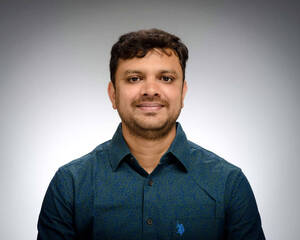
Shivakumar: I developed cryo-TEM expertise and adapted to SPA workflows during postdoctoral training here at Notre Dame and The Ohio State University. I have hands-on experience with both Glacios and Krios cryo-TEM systems, including screening, optimization, and high-quality data collection for a wide range of samples like proteins and nucleic acids. Part of my job is to develop, implement, and maintain standard operating procedures for the facility that ensure safe instrument operation and high-quality data generation for all users.
Who can use the Glacios 2, and what kind of assistance will be available for users?
Del Valle: Individual researchers and research groups within Notre Dame (as well as approved external users) pursuing structural biology studies using SPA are eligible to use the Glacios 2. Krishna will serve as the primary point of contact for researchers, providing scientific guidance and assessing the suitability of their projects for cryo-EM studies. He will perform and supervise critical and delicate operations, including grid clipping, grid loading and transfer, microscope setup, data acquisition, and troubleshooting. Krishna is also responsible for training users in plunge-freezing samples using the Vitrobot™ system, as well as training in sample screening using automated acquisition software.
Shivakumar: All training and scheduling for both the Vitrobot system and the Glacios 2 cryo-TEM will be managed through iLab, which will serve as our centralized platform for user access, reservations, and billing. Access to the instrument will be granted to users with verified, high-quality samples. Priority access will be given to samples that have undergone negative-stain EM screening to assess homogeneity and suitability prior to cryo-EM grid preparation. On rare occasions, independent operation by expert users may be permitted.
A full SPA workflow includes sample preparation, sample screening, data acquisition, and data processing and analysis. It is important to note that the final step in the process – data processing and analysis – is the responsibility of the user, not the facility. The facility will offer only limited computational support, including temporary data storage and access to processing resources for datasets generated on-site.
How can researchers get more information and schedule training or use of the Glacios 2?
Shivakumar: In addition to receiving updates through BELS email communications, researchers may contact me directly at kshivaku@nd.edu to ask questions and to discuss the suitability of their projects for cryo-EM studies.
To be the first to know when the Glacios 2 is available for use, sign up for BELS emails.
Originally published by at strategicframework.nd.edu on March 16, 2026.